
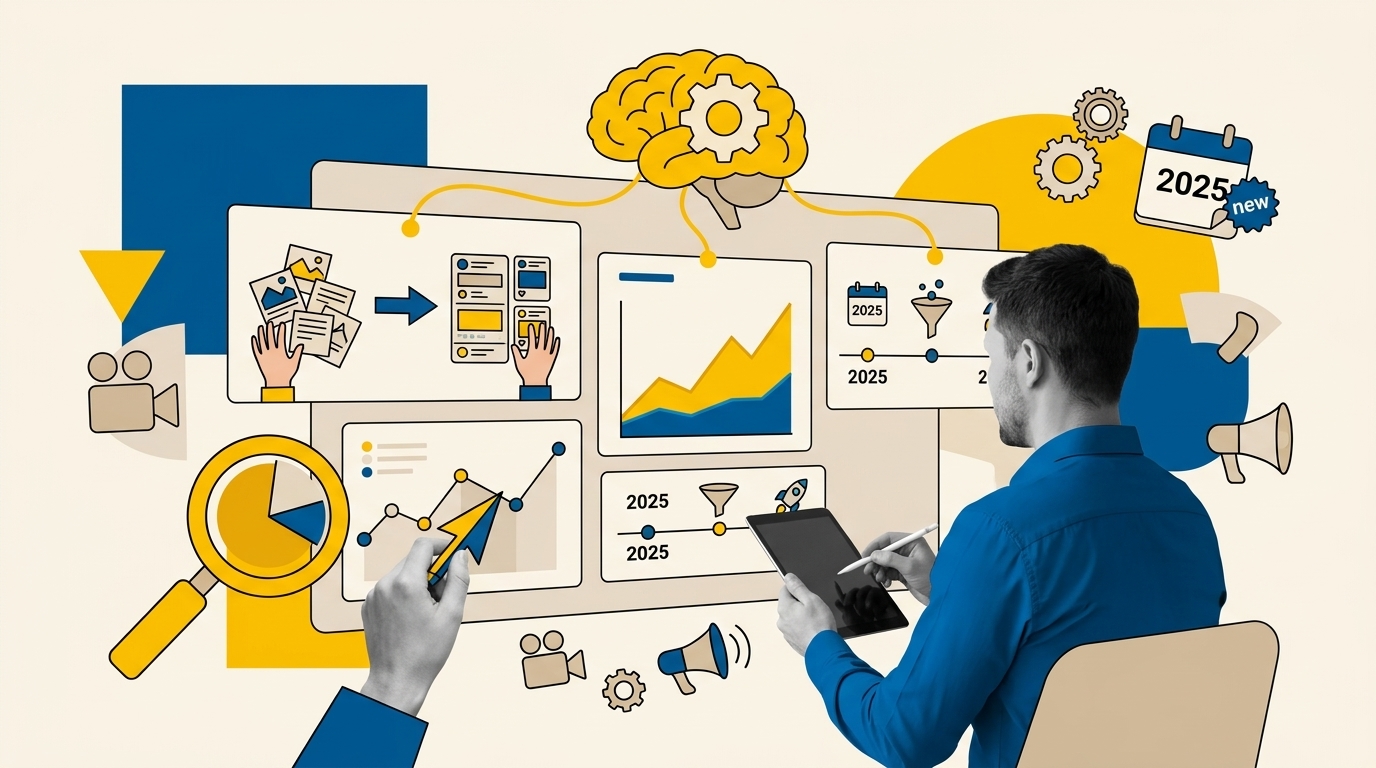
The conversation around ai changing jobs has moved well past speculation. For anyone running paid campaigns, managing content operations, or reporting on marketing performance, the shift is already visible in daily work. Tools that once required a specialist now sit inside your existing stack. Tasks that filled afternoons complete in minutes. The real question is not whether AI is changing marketing jobs but which specific skills are becoming less valuable, which are becoming more valuable, and what a lean marketing team should actually do about it right now.
This hub page collects the clearest evidence, the most useful frameworks, and links to the hands-on guides we have published across each affected area. Bookmark it as a reference point and revisit it as the picture keeps moving.
What the Evidence Actually Shows About AI and Employment
AI is restructuring tasks inside jobs far more than it is eliminating jobs outright, at least so far. The distinction matters for how you plan your career and your team.
The World Economic Forum’s Future of Jobs Report 2025 estimates that 170 million new roles will be created by 2030 while 92 million are displaced, for a net gain of around 78 million jobs globally. The same report identifies analytical thinking, creativity, and technology literacy as the fastest-growing skill clusters across industries. Marketing sits squarely at that intersection.
What the aggregate numbers hide is the task-level disruption happening inside roles that still exist on paper. A McKinsey Global Institute analysis found that roughly 30 percent of hours worked across the US economy could be automated with currently available technology, with the highest exposure in data collection, data processing, and predictable physical work. In marketing specifically, that translates directly to manual reporting, templated copywriting, and routine audience segmentation.
For the marketers reading this, the headline is: your job title will probably survive, but a significant portion of what fills your current week is already automatable, and the value of your role will increasingly depend on what you do with the time that frees up.
Which Marketing Tasks Are Shifting First
The clearest pattern is that AI is absorbing the retrieval and assembly layer of marketing work before it reaches the judgment and strategy layer.
Tasks that are shifting fastest include: pulling and formatting performance data from ad platforms, writing first-draft copy against a brief, resizing and adapting creative assets, building keyword lists, researching competitor positioning, drafting email sequences, and generating social captions at scale. None of these are gone as disciplines. All of them are changing in how long they take and who needs to do them.
According to a 2024 Salesforce State of Marketing report, 75 percent of marketers are already using or experimenting with AI, and the top use cases are content creation, data analysis, and campaign personalization. That adoption curve is steep enough that teams not experimenting now are accumulating a skill gap, not just a technology gap.
Tasks that are shifting more slowly include: campaign strategy and budget allocation decisions, brand voice and positioning, stakeholder communication, creative direction, and anything requiring deep institutional knowledge of a specific audience or market. These are not immune, but they are where human judgment still delivers clear returns over raw AI output.
The Roles Feeling the Most Pressure
Some marketing roles are absorbing more disruption than others, and it is worth being direct about which ones.
Junior copywriters working on high-volume, templated output face the most immediate pressure. Not because the writing craft is obsolete but because the per-unit economics of templated content have collapsed. A single operator with a well-structured prompt library and a capable model can now produce what previously required a small team. The surviving path in content is moving toward editorial judgment, creative strategy, and quality control rather than raw production volume.
SEO specialists focused primarily on keyword research and on-page optimization checklists are seeing their differentiation erode as AI tools commoditize those workflows. The role is not disappearing, but the specialist who only does what a well-configured AI tool can also do is in a weaker position than one who combines technical authority, content strategy, and interpretation of search intent.
Paid media analysts who spend most of their time pulling reports and formatting data are similarly exposed. As platforms build more automation into bidding and targeting, and as AI reporting tools close the loop on data assembly, the value shifts toward interpretation, testing strategy, and cross-channel judgment.
Mid-level generalist marketers are, somewhat counterintuitively, in a reasonably strong position. The ability to work fluently across channels, brief AI tools effectively, evaluate output critically, and translate results into business decisions is harder to replace than any single specialist skill executed in isolation.
The Skills That Are Gaining Value
Knowing which skills are gaining value is more actionable than cataloguing what is being lost. Here is what the evidence points toward for marketing specifically.
Prompt engineering and AI tool fluency. This is the most immediate practical skill. The ability to write clear, structured prompts, evaluate output quality, iterate efficiently, and build reusable workflows is already separating fast teams from slow ones. It is learnable quickly and applies across almost every marketing function. [LINK: prompt engineering for marketing beginners]
Data interpretation over data assembly. Pulling a report is becoming a solved problem. Knowing what a trend in your data means for next month’s budget decision is not. Marketers who build genuine analytical fluency, including comfort with dashboards, attribution models, and experimentation frameworks, are harder to replace than those who rely on AI to surface insights without the ability to pressure-test them.
Strategic briefing. As more execution moves to AI tools, the quality of what goes in determines the quality of what comes out. Writing a tight creative brief, a structured content strategy, or a precise testing hypothesis is becoming a core lever on output quality. Teams that invest in brief quality are seeing compounding returns.
Cross-functional communication. AI can draft a strategy document, but it cannot navigate organizational politics, build trust with a skeptical CFO, or translate a technical finding into a board-level recommendation. These remain human skills with high and growing premium.
A 2023 IBM Institute for Business Value survey found that 40 percent of the global workforce will need to reskill over the next three years as a result of AI adoption, with the emphasis shifting toward STEM skills but also toward collaboration, flexibility, and communication. For marketers, the communication half of that equation is where the defensible advantage lives.
[LINK: AI skills roadmap for marketing practitioners]
What This Means for Your Team Structure
If you manage a lean marketing team, AI changing jobs has a direct implication for hiring, task allocation, and how you think about headcount.
The most common shift we are seeing among small and mid-sized marketing teams is toward fewer but more senior generalists supported by AI tooling, with specialist freelancers brought in for specific campaigns or technical work rather than maintained as full-time staff. This is not universally the right structure, but it reflects the economics of the current moment: AI has lowered the floor on execution quality and speed enough that a capable generalist with good tools can now cover what previously required two or three narrower roles.
The practical implication for team leads is to audit your current team’s time allocation before making any structural change. Identify which tasks are already being partially automated, which should be, and where genuine human judgment is still doing the work. That audit usually reveals more opportunity to redeploy existing capacity than to hire or cut.
[LINK: marketing team AI readiness audit template]
On the hiring side, prioritize demonstrated AI fluency over claimed familiarity. Ask candidates to walk through how they would use an AI tool to complete a specific task relevant to the role, then evaluate the output. The gap between people who have genuinely built workflows and those who have experimented casually is large and easy to surface in a structured interview.
The Certification and Learning Landscape
One concrete response to AI changing jobs is the growth of AI-focused certifications and structured learning programs aimed at marketing practitioners. The landscape has expanded quickly, and the quality varies considerably.
The most practically useful programs right now are those tied to specific tools and workflows rather than broad conceptual frameworks. Certifications from platform providers like Google, HubSpot, and Meta cover AI features within those ecosystems and translate directly to day-to-day work. Independent programs focused on prompt engineering, AI-assisted analytics, or marketing automation tend to be valuable when they include hands-on exercises with real tools rather than slide-deck theory.
The honest assessment of most AI marketing certifications is that the credential itself matters less than the competence it builds. Hiring managers in marketing are currently more likely to ask for a portfolio of AI-assisted work than to weight a certificate heavily. Build the skills, document the outputs, and the credentials become supporting evidence rather than the primary signal.
According to LinkedIn’s 2024 Workplace Learning Report, AI literacy is now the fastest-growing skill category on the platform, with course enrollments in AI-related topics up more than 160 percent year over year. The demand for structured learning is real, and the supply is catching up, though unevenly.
A Practical Framework for Responding Right Now
Across the evidence and the hands-on work we do at Boost With AI, three principles hold up as the most reliable guide for marketers navigating this shift.
First, automate the retrieval layer before the judgment layer. Start with the tasks in your week that are pure data assembly or templated output. Build workflows that handle those consistently and well. Protect your attention for the decisions those outputs inform. The productivity gain from this step alone is typically significant enough to justify the time investment in setting it up correctly.
Second, treat AI output as a draft, not a decision. The marketers running into trouble with AI tools are mostly doing so because they are accepting generated output without the editorial or analytical review that transforms a draft into a finished work product. The human judgment step is not optional. It is where the quality and defensibility of the work live.
Third, document what you build. Prompt libraries, workflow templates, briefing frameworks, and evaluation rubrics are organizational assets. Teams that treat AI workflows as something built once, documented, and shared across the team accumulate a compounding advantage over those where every individual reinvents the process. [LINK: building a marketing AI workflow library for your team]
The picture of AI changing jobs in marketing will keep shifting. The teams and individuals who stay useful through that shift are the ones treating it as an ongoing practice rather than a one-time adjustment. Use this hub as the starting point, follow the detailed guides for the workflows that apply most directly to your current role, and revisit as the landscape evolves.
