
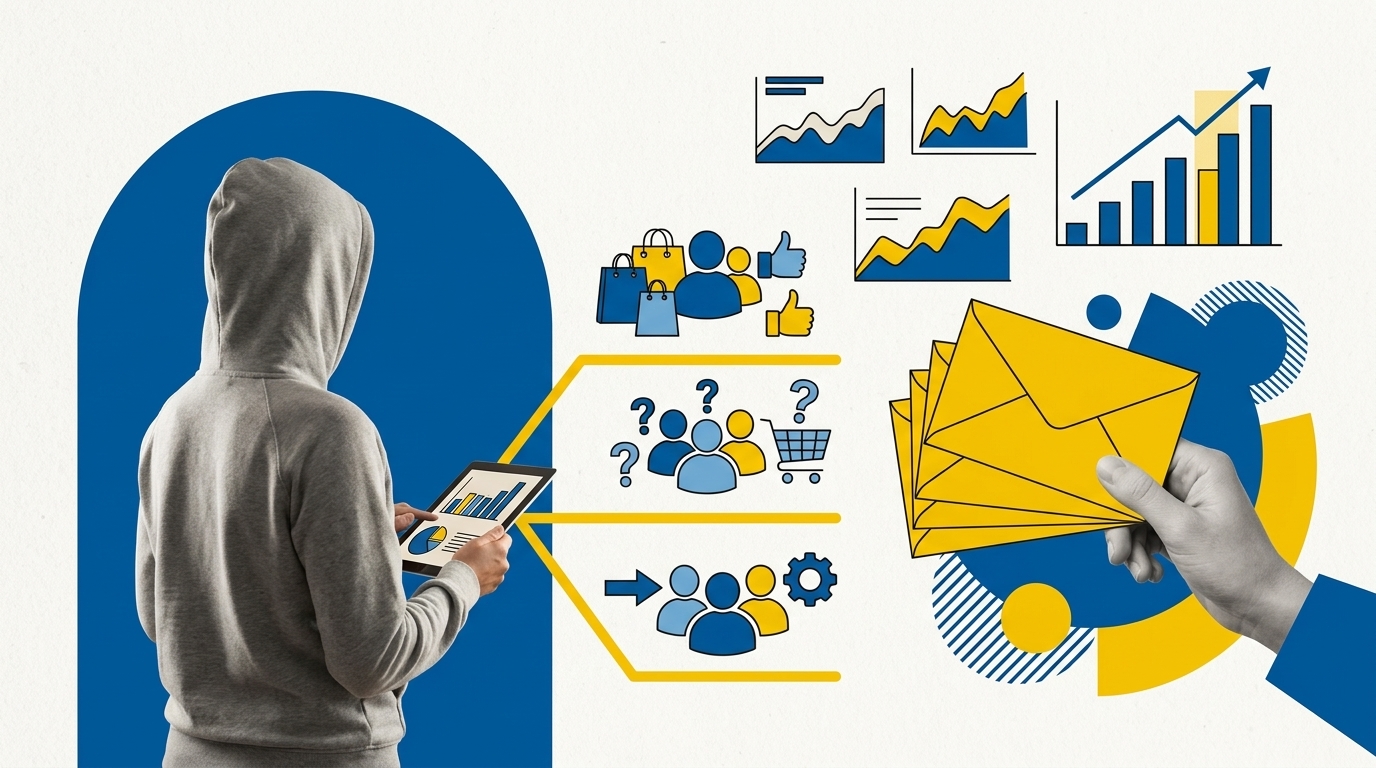
Lean ecommerce brands can scale repeat purchases by combining native store segmentation with generative AI message personalization. Effective ai customer retention segmentation does not require exporting sensitive customer databases into public AI chatbots; it relies on structured purchase cohorts, strict data minimization, and disciplined holdout testing to measure real revenue lift.
Key Takeaways
- Keep raw personally identifiable information (PII) inside your ecommerce platform or ESP; never paste real customer names, emails, or order histories into external AI tools.
- Segment your customer base by behavioral RFM metrics (Recency, Frequency, and Monetary value) rather than arbitrary demographics.
- Use generative AI to draft targeted copy variants based on pre-defined offer guardrails, verified product specs, and distinct segment friction points.
- Validate every retention campaign with holdout testing to confirm incremental repeat orders instead of taking credit for purchases that would have happened anyway.
Why Customer Retention Needs Behavioral Data
Acquiring a new customer through paid social or search channels is consistently more expensive than driving a repeat order from someone who already trusts your catalog. However, blasting an identical weekly discount newsletter to your entire subscriber list erodes margin, increases unsubscribe rates, and trains shoppers to wait for markdowns. A tighter AI lead follow-up workflow — one defined job per message, rather than a generic blast — is the same discipline you want in retention email, even though that guide starts with new enquiries rather than repeat buyers.
Sustainable repeat purchase revenue relies on identifying where each customer stands in their lifecycle. A shopper who placed their first order four days ago needs clear post-purchase guidance, unboxing tips, or cross-sell recommendations that complement what they bought. In contrast, a high-value customer who spent substantial amounts six months ago but has not returned requires a re-engagement angle focused on replenishment or new product drops.
Native segmentation tools in platforms like Shopify Customer Segmentation allow store operators to group customers by order count, total spend, and purchase recency. When you pair these rule-based filters with generative AI for drafting campaign copy, you can deliver tailored messaging at scale without hiring an agency team.
Data Privacy and Consent Guardrails
The biggest risk in modern marketing workflows is feeding confidential store data into public language models. You should never paste customer names, email addresses, physical shipping locations, or granular purchase timestamps into a web prompt. Doing so violates customer trust and can breach privacy statutes.
Before launching automated retention flows, review our marketing compliance checklist for AI tools under GDPR to ensure your data minimization protocols are sound. Under global data protection rules, processing customer data requires an appropriate legal basis, transparent policies, and strict minimization.
Similarly, all promotional retention emails must adhere to marketing standards such as the FTC CAN-SPAM Compliance Guide. Every retention email must include an honest subject line, your accurate physical postal address, and a clear, functional one-click unsubscribe mechanism. Keep segmentation rules inside your Email Service Provider (ESP), and feed your AI tools only anonymized cohort personas and verified product facts.
How Does AI Customer Retention Segmentation Work?
The most reliable retention framework remains RFM: Recency, Frequency, and Monetary value. Recency tracks how many days have elapsed since the customer last completed a checkout. Frequency measures the total number of historical orders. Monetary value evaluates cumulative lifetime spend.
Instead of relying on black-box algorithms that create uninterpretable clusters, lean brands should define deterministic RFM rules inside their ESP or store backend. AI functions best downstream: taking those distinct cohort boundaries and drafting targeted copy, subject line variants, and offer angles suited to each group’s specific motivation.
The following table illustrates how a store can translate purchase activity into structured cohorts and targeted campaign strategies.
| Segment Name | Behavioral Criteria (Illustrative) | Primary Retention Job | AI Content Focus |
|---|---|---|---|
| First-Time Recent | 1 order, 1 to 14 days ago | Build trust, reduce buyer remorse, guide usage | How-to tips, complementary product pairings |
| Active Repeat | 2+ orders, last order < 45 days ago | Accelerate next purchase, build brand habit | Early access announcements, replenishment reminders |
| High-Value VIP | Top 10% spend, ≥ 3 orders | Protect loyalty, maximize lifetime value | Founder notes, exclusive previews, premium perks |
| At-Risk / Lapsing | 2+ orders, 60 to 120 days of inactivity | Win back lapsed interest before churn | Catalog updates, satisfaction check, curated incentives |
The Four Core Ecommerce Retention Segments
To keep operations manageable, lean teams should avoid building dozens of hyper-specific flows. Focus on four core cohorts that cover the majority of repeat revenue opportunities.
1. Recent First-Time Buyers
This cohort includes customers who placed their initial order within the last 1 to 21 days. The primary goal is onboarding, not aggressive upselling. The same logic as a structured SaaS trial onboarding email sequence applies here: teach and reassure in the first days before you sell again. If a customer ordered a coffee brewing kit, sending a promotional email three days later demanding they buy more coffee feels tone-deaf. Instead, provide educational tips on grind size and water temperature, followed by a replenishment offer once the initial bag is likely depleted.
2. Repeat Core Customers
These buyers have purchased two or three times and represent your predictable baseline. They do not need basic brand education. Instead, they respond to frictionless replenishment sequences, relevant category cross-sells, or invitations to join an automated subscription model.
3. VIP Spenders
Your top tier typically accounts for an outsized portion of gross margin. Treat them accordingly. Avoid discounting; price cuts can cheapen the perceived brand value among customers who have already demonstrated willingness to pay full price. Focus on high-touch engagement, concierge support, and early access to limited batch releases.
4. Lapsed or Churn-Risk Buyers
When a previously active buyer goes past your store’s average repurchase window (for example, exceeding 90 days between orders), their churn probability rises significantly. Your campaign must acknowledge their hiatus, showcase genuine product improvements or new arrivals, and present a compelling reason to revisit. The same discipline used when you analyze lost sales enquiries and CRM notes with AI applies here: tag why people went quiet, keep an unknown bucket, and do not invent motives.
How to Draft Segment-Specific Copy with AI
Generative AI excels at translating product specifications into tone-adapted marketing copy. However, AI models hallucinate features, dimensions, return windows, and pricing if unconstrained. To maintain accuracy, establish a strict prompt structure that provides verified product facts and explicit boundary rules. Ground the segment voice in qualitative patterns, not just RFM scores; our AI customer research workflow shows how to turn interviews and reviews into messaging pillars you can drop into the prompt below.
Before publishing any AI-generated drafts, apply our 12-point AI marketing copy QA checklist to vet claims, links, and tone consistency. Never allow an unedited AI draft to enter an automated ESP flow.
Copy-Paste Prompt Template for Message Drafting
Use the following reusable prompt template in your internal AI workspace. Notice that it relies entirely on synthetic, anonymized persona inputs rather than individual customer records.
Role: Senior Ecommerce Email Copywriter
Context: We run a specialty direct-to-consumer store. We are creating a retention email campaign for an existing customer segment.

Segment Persona: High-Value VIP (Placed 3+ orders, average order value $110, has not purchased in 45 days).
Objective: Introduce our new seasonal release with early-access positioning. Do not offer discounts or markdowns.

Approved Product Facts:
- Product Name: Reserve Roast Batch #4
- Tasting Notes: Dark chocolate, toasted hazelnut, cherry finish
- Roast Level: Medium-Dark
- Shipping Policy: Free standard shipping on orders over $50
- Availability: Limited batch of 500 bags

Writing Rules:
- Provide 3 subject line options (under 50 characters, no spam triggers like 'Act Now' or 'Massive Sale').
- Provide 1 concise body copy draft (under 120 words).
- Maintain a refined, appreciative tone that recognizes their ongoing support.
- Highlight the limited inventory and early access window.
- End with a single clear call-to-action button text.
How to Measure Incremental Revenue and QA Campaigns
A common pitfall in retention marketing is confusing attributed revenue with incremental revenue. If an automated email generates $5,000 in sales, how much of that revenue would have occurred naturally without the message?
To uncover true incremental lift, implement a 5% or 10% holdout group in your ESP. A holdout group consists of eligible segment members who match all criteria but are intentionally suppressed from receiving the campaign. By comparing the repeat purchase conversion rate of the test group against the holdout group over a 14-day or 30-day window, you can calculate the net incremental revenue generated by your campaign.
Retention Experiment Measurement Sheet
Track your experiments systematically using these core metrics:
- Total Segment Size: Number of unique consented profiles meeting filter criteria.
- Test Group (90%): Profiles receiving the AI-drafted retention campaign.
- Holdout Group (10%): Profiles meeting criteria but receiving zero promotional messages.
- Test Conversion Rate: Percentage of the test group placing an order within 30 days.
- Holdout Conversion Rate: Percentage of the holdout group placing an order within 30 days.
- Incremental Conversion Lift: Test Conversion Rate minus Holdout Conversion Rate.
- Unsubscribe & Spam Rate: Health metrics to ensure messaging frequency remains sustainable.
Frequently Asked Questions
No. Uploading identifiable customer records, including names, emails, addresses, or unaggregated order histories, to public AI tools risks breaching privacy regulations and customer trust. Always keep customer records inside your secure ecommerce platform or ESP, and use AI only with anonymized cohort descriptions and approved product details.
Attributed revenue credits a campaign for any purchase made within a specific attribution window after an email is opened or clicked. Incremental revenue measures only the additional purchases directly caused by the email, verified by comparing conversion rates against an un-emailed holdout group.
Most modern ecommerce and ESP platforms calculate rule-based segments dynamically in real time. As soon as a customer completes an order or surpasses an inactivity threshold, their segment membership updates automatically, ensuring automated flows trigger at the right time.
