
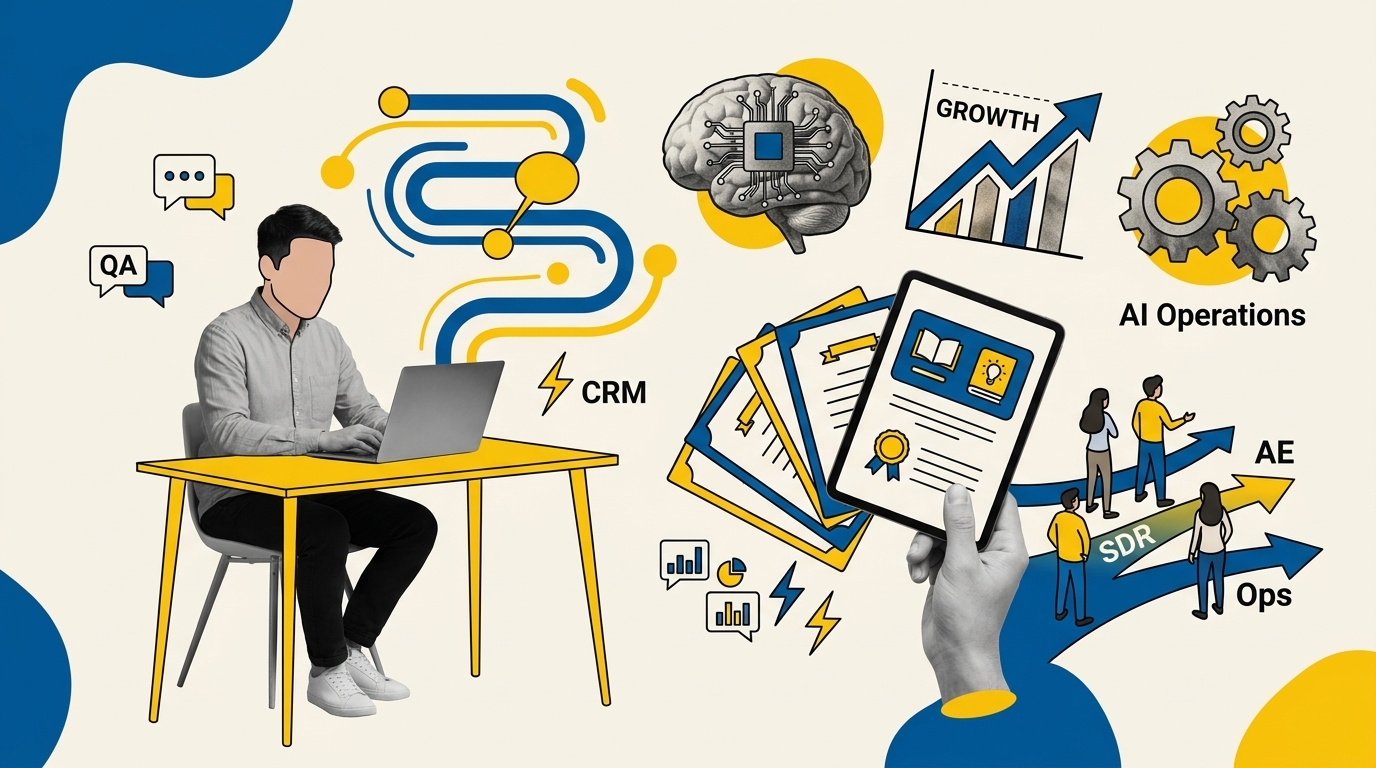
Sales professionals do not need computer science degrees to use artificial intelligence effectively, but generic prompt tutorials fail to address the core demands of daily quota execution. The most practical free AI courses for sales professionals focus on concrete revenue operations: account research, contextual outbound messaging, meeting transcription synthesis, CRM data hygiene, and pipeline forecasting. Free training from industry leaders like HubSpot Academy and Salesforce Trailhead provides structured learning paths, but sales reps and revenue operations leaders must understand the distinct operational scope, credential weight, and software access requirements of each program.
Key Takeaways
- Free educational courses, digital completion badges, and formal proctored certifications carry vastly different professional weight; never confuse course completion records with certified technical credentials.
- SDRs benefit most from fast micro-courses that teach verified prospect research and message drafting, while AEs require training in meeting synthesis, qualification frameworks, and deal acceleration.
- Sales Operations professionals should target structured cohort bootcamps and ecosystem modules that address data governance, CRM enrichment, and automated scoring rules.
- While coursework is free, fully replicating vendor-specific features like HubSpot Breeze Intelligence or Salesforce Agentforce often requires paid enterprise CRM licenses.
- Outbound prospecting powered by generative AI must strictly adhere to legal privacy frameworks (such as GDPR, PECR, and CAN-SPAM) alongside manual factual verification to avoid domain blacklisting and compliance violations.
Navigating Free Sales AI Credentials
Before investing hours in online training, revenue professionals should establish clear expectations regarding what free AI learning materials deliver. Vendor educational platforms use varied terminology, ranging from micro-learning badges to formal accreditations, and understanding these distinctions prevents misplaced professional claims.
Educational offerings in modern sales AI generally fall into three distinct tiers:
- Self-Paced Micro-Courses: Typically 30 to 90 minutes of video lessons and multiple-choice quizzes. These grant an account-linked certificate of completion or course achievement badge. They validate baseline knowledge of concepts but do not indicate hands-on mastery.
- Gamified Platform Badges: Modules like those on Salesforce Trailhead that award experience points (XP) and digital profile badges. They indicate conceptual familiarity with a specific software ecosystem and its architectural vocabulary.
- Cohort Bootcamps and Formal Certifications: Multi-week applied programs or proctored assessments. While some educational tracks are free, full professional accreditation often involves capstone project grading, structured cohort participation, or supervised technical exams.
Completing a free learning path does not guarantee a job offer, promotion, or measurable revenue growth. Its primary value lies in teaching structured systems that reduce administrative drag, improve data accuracy, and sharpen your daily customer research. For foundational techniques on turning raw market transcripts into structured positioning, review our practical guide on the AI customer research workflow.
Top Free AI Sales Courses Evaluated
Three free offerings from major CRM vendors provide direct, practical training for revenue teams. Each carries distinct requirements, curricula, and credential outputs.
| Course / Program | Provider | Format & Duration | Credential Type | Key Revenue Focus Areas |
|---|---|---|---|---|
| AI for Sales | HubSpot Academy | Self-paced (~36 minutes) | Course Completion (Not a formal certification) | Prospect research, deal scoring, Breeze task automation, forecasting |
| AI for Marketing, Sales, and Service Bootcamp | HubSpot Academy | Cohort-based (6 weeks) | Applied Certification (Upon capstone approval) | Cross-functional GTM workflows, portal automation, agentic use cases |
| Generative AI for Organizations (Sell Smarter) | Salesforce Trailhead | Self-paced (~30 minutes) | Trailhead Digital Badge (300 points) | Agentforce basics, email generation, CRM summary notes, AI ethics |
1. HubSpot Academy: AI for Sales
HubSpot Academy’s AI for Sales course is a concise, foundational entry point designed for busy front-line representatives. Across approximately 36 minutes of video content and knowledge checks, the curriculum addresses daily sales bottlenecks: identifying relevant target accounts, scoring opportunities, automating repetitive administrative tasks, and interpreting pipeline projections.
The lessons introduce native platform capabilities, including HubSpot Breeze AI features for prospecting and summarization. It is vital to note that completing this course provides a digital completion record on your HubSpot Academy profile, not an official HubSpot certification badge. The instruction is completely free, though utilizing live Breeze automation features inside a commercial portal requires corresponding paid software licenses.
2. HubSpot Academy: AI for Marketing, Sales, and Service Bootcamp
For revenue team members seeking deep, applied experience, the AI for Marketing, Sales, and Service Bootcamp offers a rigorous, 6-week cohort structure. Rather than passive video viewing, this program requires participants to attend live sessions, complete hands-on portal exercises, and submit a capstone project for evaluation.
Because it is an intensive program with limited capacity, enrollment operates on an application basis across seasonal cohorts. Successful completion awards an official certification credential. It is ideal for revenue operations leaders and senior sales reps who need to build repeatable, cross-departmental automation systems.
3. Salesforce Trailhead: Generative AI for Organizations
Salesforce Trailhead offers the Generative AI for Organizations module, featuring the dedicated unit “Sell Smarter with Generative AI.” This free 30-minute self-paced module introduces the fundamentals of large language models within enterprise revenue architectures.
The coursework focuses on how Salesforce Einstein and Agentforce assist reps in summarizing complex account histories, drafting tailored client correspondence, and logging call outcomes directly to standard CRM objects. Completing the unit awards 300 points and a shareable Trailhead digital badge. While it is an excellent demonstration of platform literacy, it should not be confused with paid, proctored credentials such as the Salesforce Certified AI Associate exam.
Role-Based Learning Pathways: SDR, AE, and Sales Ops
Generic study plans waste time. Different sales roles face different daily operational hurdles, requiring distinct learning pathways.
Sales Development Representatives (SDR / BDR)
SDRs operate in high-volume, initial-touch environments. The priority is rapid account context synthesis and authentic, tailored outbound messaging that avoids spam triggers.
- Recommended Baseline: HubSpot AI for Sales.
- Core Competency to Develop: Prompting models to synthesize company 10-K filings, press releases, and executive interviews into three relevant business pain points.
- Operational Rule: Never allow an AI tool to send outreach autonomously. Reps must manually audit every generated message for accurate facts, recipient tone, and proper opt-out mechanics.
Account Executives (AE)
Account Executives manage multi-stakeholder evaluations, discovery conversations, and contract negotiations. Administrative friction during call logging and proposal drafting directly degrades selling time.
- Recommended Baseline: Salesforce Trailhead: Generative AI for Organizations (Sell Smarter unit).
- Core Competency to Develop: Transforming 45-minute discovery call transcripts into structured MEDDPICC or BANT opportunity notes, follow-up action summaries, and risk logs.
- Operational Rule: Strip sensitive customer financials and unreleased product roadmaps before processing unstructured transcripts in general-purpose models.
Sales Operations and Revenue Operations (Sales Ops / RevOps)
Sales Ops professionals build the technical infrastructure that enables front-line reps to close deals. They require a systemic perspective on data models, enrichment, and pipeline accuracy.
- Recommended Baseline: HubSpot AI Bootcamp alongside advanced Trailhead Agentforce administration trails.
- Core Competency to Develop: Constructing automated qualification logic, auditing CRM field population, and testing predictive scoring models. To explore architectural frameworks for algorithmic qualification, read our analysis of automated lead scoring with AI.
- Operational Rule: Enforce strict validation rules on all AI-enriched CRM data to prevent corrupted pipeline reporting and inaccurate revenue forecasts.
Prospecting and CRM Hygiene Framework
To extract value from AI coursework, practitioners must apply structured prompt frameworks to real daily workflows. Below is a tested, multi-step prompt structure designed for account research and deal logging.
1. Contextual Account Research Prompt (SDR / AE)
Use this prompt template when preparing for an outbound sequence or discovery meeting. Run it in a secure, business-grade AI interface:
Role: B2B Enterprise Sales Researcher
Input Data:
- Target Company: [Insert Company Name and Website]
- Target Persona: [Insert Title, e.g., VP of Customer Experience]
- Public Triggers: [Paste recent press release excerpt, earnings call snippet, or quarterly priority]
Task:
1. Identify 2 primary operational friction points this executive likely encounters based on the provided triggers.
2. Draft 3 discovery questions tailored to these friction points, avoiding buzzwords.
3. Propose 1 concise outreach angle (under 90 words) referencing the trigger directly.
Constraint: Do not invent partnerships, revenue metrics, or software dependencies not explicitly stated in the input data.
2. Meeting Call Summary and CRM Extraction Prompt (AE)
After an initial discovery call, process the raw transcript through this extraction framework to populate CRM fields accurately:
Role: Sales Operations Specialist
Input: [Paste raw call transcript excerpt]
Task: Extract structured deal data according to this schema:
- Stated Business Problem: [Direct quote or factual summary]
- Current Tech Stack Mentioned: [List verified tools only]
- Decision Timeline & Next Steps: [Specific date and agreed owner]
- Risk / Red Flags: [Budget constraints, competitor mentions, or security hurdles]
Constraint: If a field was not discussed during the call, write "Not Discussed". Do not infer or guess unmentioned details.
Privacy, Compliance, and Outreach Guardrails
Speed without governance leads to burned domain reputations and legal liabilities. Generative AI makes it trivially easy to generate hundreds of outreach messages per hour, but regulatory bodies and email service providers strictly penalize unverified automated communication.
When deploying AI-assisted outreach, adhere to these three core frameworks:
- United States (CAN-SPAM): Enforced by the FTC, outbound commercial email must include a clear, non-deceptive subject line, the sender’s physical postal address, and an unambiguous, functioning opt-out mechanism. Generative AI tools frequently propose click-bait subject lines that violate non-deception standards; reps must actively edit them.
- Europe and UK (GDPR and PECR): Cold outreach to named corporate individuals requires an established legal basis, commonly Legitimate Interests, supported by a formal assessment. Recipients possess an absolute right to object. AI systems must not enrich prospect lists using scraping methods that violate data minimization rules. For detailed operational standards, consult our guide on using AI tools under GDPR.
- Domain Deliverability and Hallucination Controls: Sending high volumes of AI-generated messages with factual errors, hallucinated case studies, or fabricated mutual connections damages sender reputation and triggers spam filters. Always verify cited customer references and statistics before hitting send.
Building an Auditable Sales Portfolio Project
Because free course badges are accessible to anyone, demonstrating applied competence requires verifiable work samples. Building a synthetic portfolio project proves to sales leadership that you understand how to use AI responsibly and effectively.
The 4-Step Synthetic CRM and Prospecting Asset
- Generate Synthetic Account Profiles: Create three fictional target accounts representing your ideal customer profile (for example, a mid-market logistics firm, a regional healthcare network, and a fintech scale-up). Detail their synthetic employee count, estimated annual tech budget, and operational constraints. Never use proprietary employer or client data in public portfolio projects.
- Execute Contextual Prospect Research: Using publicly accessible templates, produce a two-page account research dossier for each synthetic firm. Document the exact prompt chains used, the verification steps taken to confirm the synthetic data, and the resulting persona profiles.
- Develop an Outbound Messaging and QA Audit Sheet: Draft three personalized cold email variants for each account persona. Accompany each variant with a completed Quality Assurance scorecard validating compliance with CAN-SPAM, value proposition accuracy, and tone consistency.
- Build a CRM Stage Transition Log: Map out an illustrative opportunity pipeline record. Show how raw call transcripts are synthesized into standard CRM opportunity objects, highlighting the criteria used to progress an opportunity from “Discovery Completed” to “Solution Evaluation.”
Packaging these four assets into a clean, read-only document demonstrates practical revenue literacy far more effectively than listing a completed micro-course badge on a resume.
Frequently Asked Questions
Are free sales AI certificates respected by hiring managers?
Free course completion certificates from HubSpot Academy or Salesforce Trailhead demonstrate professional curiosity and platform awareness, but hiring managers treat them as baseline continuing education rather than accredited qualifications. To stand out, combine course completion with an auditable portfolio project demonstrating real prompt QA, compliant outbound sequences, and structured CRM data management.
Do I need an active HubSpot or Salesforce subscription to take these courses?
No. Both HubSpot Academy and Salesforce Trailhead provide completely free educational access. You can view video lessons, read curriculum documentation, and complete assessment quizzes without entering credit card information or maintaining a paid subscription. However, replicating advanced proprietary features shown in the coursework, such as HubSpot Breeze Agents or Salesforce Agentforce Sales Cloud add-ons, requires corresponding commercial software licenses in an active portal.
Can I automate cold email outreach entirely using generative AI?
Technically yes, but operationally and legally it is highly inadvisable. Fully autonomous outreach pipelines frequently introduce factual hallucinations, awkward phrasing, and compliance violations under CAN-SPAM and GDPR. High-performing sales teams use AI to draft initial copy and summarize research, but enforce mandatory human-in-the-loop QA before any message is transmitted to a prospect.
What is the difference between a Trailhead badge and a Salesforce Certification?
A Trailhead badge is a digital reward earned by completing an unproctored online learning module and passing a short multiple-choice quiz or practical challenge. A Salesforce Certification (such as the Salesforce Certified AI Associate) is a formal, proctored exam requiring identity verification, adherence to strict testing conditions, and an examination registration fee. Badges reflect informal module completion, whereas certifications represent standardized technical accreditation.
