Key Takeaways
- AI hallucination is when a chatbot generates false information, including fake citations, while sounding completely confident.
- In 2023, ChatGPT invented six entirely fake court cases for a real lawsuit, and two lawyers were fined $5,000 for citing them.
- A 2025 study testing eight AI chatbots found ChatGPT fabricated part of a bibliographic reference 38% of the time, more than every model tested except Bing.
- Hallucination happens because chatbots predict likely sounding text. They do not look anything up unless they are connected to a tool that actually retrieves documents.
- Tools built to ground every answer in a real, retrievable source cut hallucinated citations dramatically compared to general purpose chatbots.
What is an AI hallucination?
An AI hallucination is when a chatbot generates information that sounds accurate and confident but is actually false, invented, or unverifiable, including citations to sources that do not exist.
Hallucinations are not a bug that occasionally slips through. They are a structural feature of how large language models work. Every response is a prediction of what text is likely to come next, based on patterns in training data, not a database lookup of a verified fact.
Some hallucinations are obvious, like a chatbot insisting a famous landmark is in the wrong country. Others are dangerous specifically because they look correct: a real sounding author name, a real sounding journal, a citation format that is technically valid. That second kind is what trips up students, journalists, and entire law firms.
Why do AI chatbots make up fake citations?
Chatbots invent citations because they generate the most statistically likely looking citation format, not because they retrieved a real source, unless they are explicitly connected to a search or document tool.
A general purpose chatbot writes one token at a time based on patterns learned from training. When you ask “what’s the source for that,” it does not open a database and check. It generates a citation that resembles the citations it learned from: plausible author name patterns, real journal style formatting, believable years. The result reads like a citation. It just is not necessarily attached to a real paper.
This is exactly why hallucination rates spike on citation tasks specifically. A 2025 comparison of eight AI chatbots’ bibliographic accuracy found that ChatGPT fabricated at least part of a reference 38% of the time, while DeepSeek did not fabricate a single one in the sample and Gemini’s fabrication rate had dropped to 12% from 100% just two years earlier.
A real case: the lawyers who trusted ChatGPT’s fake court cases
In 2023, two New York lawyers submitted a legal brief built on six completely fabricated court cases that ChatGPT had invented, complete with fake judges, fake quotes, and fake citations.
The case, Mata v. Avianca, became the most cited cautionary tale in the legal profession. One of the attorneys, Steven Schwartz, asked ChatGPT directly whether one of the invented cases was real. According to CNN’s reporting, the chatbot insisted the case “does indeed exist and can be found on legal research databases such as Westlaw and LexisNexis.” It did not exist anywhere.
Judge P. Kevin Castel fined the lawyers and their firm $5,000 for the submission. The case was not an isolated incident either. According to legal industry reporting, a California judge fined two law firms a combined $31,000 in 2026 for citations generated by Google Gemini, and a Utah attorney was separately sanctioned for submitting a brief built on a nonexistent ChatGPT-invented case.
How common are hallucinated citations, really?
Hallucinated citations show up in roughly 30 to 38% of chatbot generated research answers in recent testing, and the rate climbs sharply on legal, medical, and specialized academic topics.
The numbers get worse the more specialized the question gets. According to a Stanford-linked legal AI study, legal research tools built specifically for lawyers, including Lexis+ AI and Ask Practical Law AI, still hallucinated more than 17% of the time on challenging queries, while Westlaw’s AI-assisted research tool hallucinated more than 34% of the time.
Even peer review does not catch everything. A January 2026 analysis found at least 100 confirmed AI-hallucinated citations spanning 53 papers accepted to NeurIPS 2025, one of the most competitive AI research conferences in the world, despite review by three to five experts per paper.
How can you tell if an AI citation is fake?
Search for the exact title and author in Google Scholar or the publisher’s own site. If it does not return a real, clickable result, treat the citation as fabricated until you can prove otherwise.
A few reliable warning signs are worth watching for: the citation looks suspiciously “perfect” for your exact question, the chatbot cannot produce a working link when pressed, or the chatbot doubles down confidently when challenged, the same way ChatGPT did in the Avianca case when it insisted a fake case was real, then reversed itself, then insisted again. None of those reactions are evidence. A chatbot sounding confident tells you nothing about whether it is right.
How do you avoid AI hallucinated citations?
The most reliable fix is using an AI tool that retrieves and quotes the actual source document, instead of a general chatbot that is only predicting what a citation should look like.
A few habits help no matter which tool you use. Always click through: if a chatbot cannot surface a working link to the real source, do not use the citation. Ask for the DOI or direct URL instead of just an author and year, since that format is harder to fake convincingly. And cross-check anything that sounds suspiciously perfect for the point you are trying to make, since that is exactly the kind of claim a model is most likely to invent on demand.
Beyond habits, the tool itself matters. General chatbots like the free tier of ChatGPT are built for fluent conversation, not citation accuracy, which is exactly why the 38% fabrication rate above exists. Tools built specifically to ground every answer in a retrievable document behave differently.
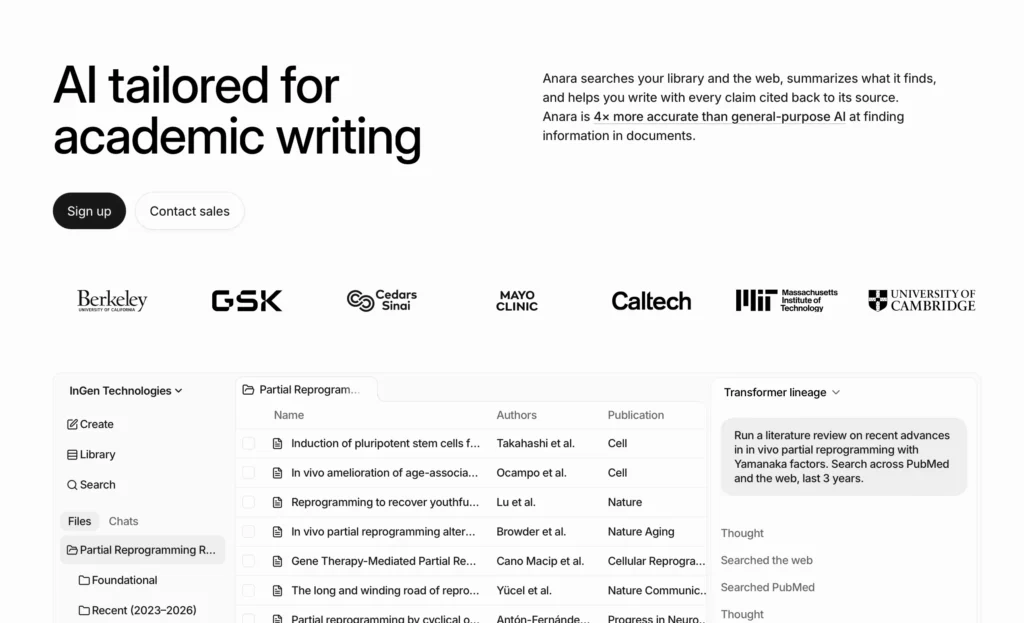
Anara, for example, searches your own uploaded files plus sources like PubMed, arXiv, and JSTOR, then attaches every answer to the exact passage it came from instead of generating a citation from memory. If you are writing something that needs verifiable sources, a thesis, a literature review, even a long blog post like this one, it is worth testing alongside whatever general chatbot you already use, not necessarily as a replacement for it.
Why Anara specifically helps with this problem
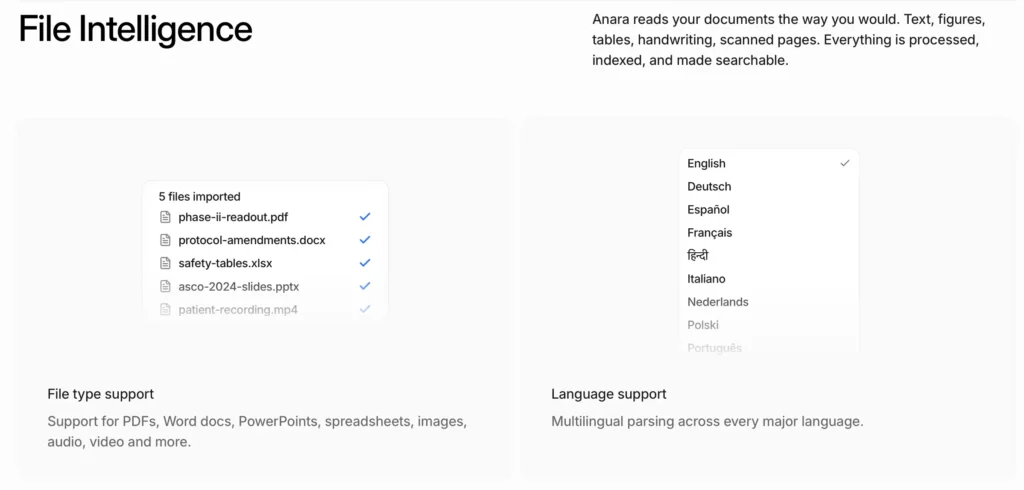
Anara‘s design starts from the same root cause this article has been describing: a chatbot that answers from memory will eventually invent something. Anara instead answers from documents it can point to directly, your own uploaded files or sources like PubMed, arXiv, and JSTOR, and shows the exact passage behind every claim so you can check it in one click instead of taking the answer on faith.
| Tool | Answer correctness |
|---|---|
| Anara | 97% |
| Copilot | 90% |
| NotebookLM | 88% |
| Perplexity | 84% |
| Claude | 81% |
| ChatGPT | 63% |
Those numbers come from a multi-document question-answering benchmark Anara ran and published itself, not an independent third party, so treat it as a vendor claim rather than settled fact. What’s verifiable independently is the underlying mechanism: citing the exact source passage instead of generating a citation from memory is the same approach that lowers fabrication rates in the academic studies cited earlier in this guide. Anara also works across up to 10,000 files in a single conversation and is SOC 2, ISO 27001, GDPR, and HIPAA compliant, with no use of your data for model training, which matters if you’re uploading unpublished drafts or sensitive research.
Frequently Asked Questions
Why does AI sound so confident even when it’s wrong?
Chatbots generate the most statistically likely next words, not a confidence score based on actual verification. There is no built-in “I’m not sure” signal in how the text gets produced, so a wrong answer reads exactly as fluent as a correct one.
Can ChatGPT fix its own hallucinations if you ask it to double check?
Sometimes, but not reliably. In the Avianca case, the lawyer directly asked ChatGPT whether a case was real, and it falsely confirmed it before eventually backing down. Asking a model to check its own work is not the same as independent verification.
Are some AI tools less likely to hallucinate than others?
Yes. Tools that retrieve and cite actual documents, rather than predicting citation-shaped text from memory, consistently show lower fabrication rates in independent testing, and the gap widens further on specialized or academic topics.
Is it safe to use AI for research papers at all?
Yes, as long as verification is built into your workflow. Use AI to find direction and summarize what you have already read, then confirm every citation independently before it goes into a paper, the same way you would check a human research assistant’s work.
What’s the fastest way to check if an AI-generated citation is real?
Paste the exact title into Google Scholar or the publisher’s site. A real source returns a clickable, matching result within seconds. If nothing relevant comes up, treat the citation as fabricated.
Related reading: For a broader breakdown of how the major chatbots compare on accuracy and everyday tasks, see our ChatGPT vs Claude vs Gemini comparison. If you are still getting comfortable with the basics, start with How to Write Better AI Prompts.

3 comments
[…] or quote. That is Anthropic’s own internal test, so verify numbers yourself; our guide to why AI makes up fake citations explains why. On writing quality, “It writes like a good colleague,” says John Ruelas, […]
[…] The budget you set is the control to understand first. Agents also make errors, as our explainer on AI hallucinations shows, so keep payments and outbound messages behind your […]
[…] Verify facts. Agents can state invented details with confidence, which we explain in why AI makes up fake citations. […]