
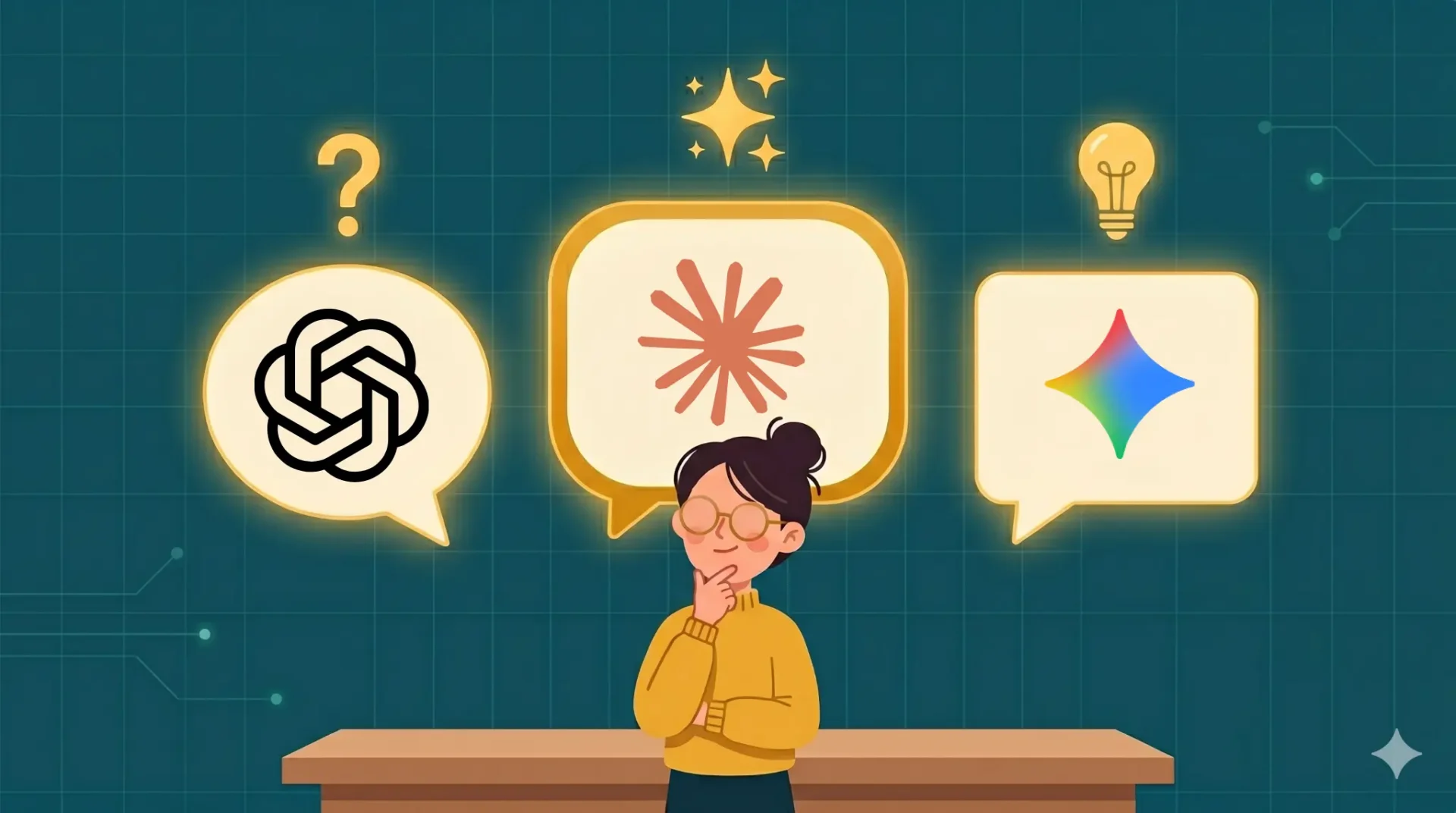
TL;DR
- ChatGPT is the most versatile all-rounder for beginners, with the largest tool ecosystem and community
- Claude is best for reading long documents, nuanced writing, and thoughtful back-and-forth conversation
- Gemini is the strongest pick if you already live inside Google Docs, Gmail, or Drive
- All three have a free tier, you do not need a paid plan to get started
- Tested in June 2026 across five real beginner tasks: email rewriting, document summarising, brainstorming, coding help, and answering factual questions
What are ChatGPT, Claude, and Gemini — and why does it matter which one you pick?
ChatGPT, Claude, and Gemini are AI assistants that generate text, answer questions, and help with everyday tasks. Each is built on a different underlying model and has different strengths — picking the right one from the start saves time and frustration.
All three work in your browser, require no technical knowledge to use, and have a free tier. The differences only matter once you start using them for specific tasks — which is exactly what this guide covers.
Here is who builds each one:
- ChatGPT is made by OpenAI, the company that kicked off the mainstream AI boom in late 2022. It has the largest user base — over 800 million weekly active users as of late 2025, according to OpenAI.
- Claude is made by Anthropic, an AI safety company founded by former OpenAI researchers. It is designed to be especially careful, nuanced, and good at handling long documents.
- Gemini is made by Google DeepMind. It is tightly integrated with Google’s existing tools — Docs, Gmail, Drive, and Search.
If you are completely new to AI tools, any of the three will feel like a superpower compared to doing things manually. The question is just which superpower fits your life best.
How do they compare side by side?
ChatGPT leads on integrations and breadth of use cases. Claude handles longer documents and deeper reasoning. Gemini connects to Google’s tools natively and has the largest context window of the three. All three are free to start.
| Feature | ChatGPT | Claude | Gemini |
|---|---|---|---|
| Free tier | ✓ | ✓ | ✓ |
| Best at | Versatility | Long writing & documents | Google Workspace |
| Context window (free) | 128k tokens (~96,000 words) | 200k tokens (~150,000 words) | 1M tokens (~750,000 words) |
| Image input | ✓ | ✓ | ✓ |
| Integrations | 1,000s via GPT Store | Growing (limited free tier) | Google apps only |
| Voice mode | ✓ Advanced Voice | ✓ Basic | ✓ Basic |
| Ideal for | General use, coding, most tasks | Writing, analysis, long docs | Gmail and Docs users |
| Paid plan starts at | $20/month | $20/month | $19.99/month |
Context window = how much text the AI can read and remember in one conversation. A larger window means you can paste in longer documents.
Which AI is best for writing and everyday tasks?
ChatGPT handles the widest range of everyday tasks — emails, summaries, brainstorming, and quick questions — making it the safest starting point for most beginners.
To test this properly, I gave all three AI tools the same task: rewrite a stiff, formal work email in a friendlier, more human tone. Here is what happened.
The original email: “Dear Sir/Madam, I am writing to follow up on the outstanding invoice number 1042. Please arrange payment at your earliest convenience.”
ChatGPT’s version hit the right tone immediately — warm but professional, with a natural opening line. It also offered two alternative versions unprompted, which is useful when you are not sure what tone you want.
Claude’s version was slightly more conversational and added a line acknowledging the recipient might be busy. It felt the most human of the three.
Gemini’s version was competent but a little generic — it got the job done, but without the personality the other two brought.
For most everyday writing tasks — emails, social media captions, blog intros, summaries — ChatGPT and Claude are roughly equal. ChatGPT edges ahead purely because of its ecosystem: there are thousands of tutorials, YouTube videos, and community threads specifically for beginners. When you get stuck, finding help is easy.
A 2025 study by Similarweb found that ChatGPT receives over 3 billion visits per month — meaning the community of people who can answer your questions is enormous compared to any other AI tool.
Which is best for students and studying?
Claude is the best AI for students who need to analyse long documents or essays — it can read and summarise up to 200,000 words in a single conversation, roughly the equivalent of a 150-page academic paper.
This matters more than most beginners realise. Imagine uploading a full research paper, a semester’s lecture notes, or a 50-page company report and asking the AI to summarise the key points, find contradictions, or quiz you on the material. Claude handles this better than the others because its 200k context window stays accurate across the whole document — it does not start forgetting things it read earlier the way smaller-window models can.
I tested this by uploading a 40-page PDF of lecture notes and asking three questions:
- “Summarise the five main arguments in this document.”
- “What evidence does the author use to support argument three?”
- “Create five quiz questions to test my understanding.”
Claude answered all three accurately, including specific page references. ChatGPT handled questions one and three well but gave a slightly vague answer to question two. Gemini summarised well but struggled with the specific evidence question.
For students, Claude’s free tier is genuinely competitive with paid plans on other tools. If your primary use case is reading, understanding, and writing about long documents, Claude is the clear winner.
Which AI is best if you use Google Docs or Gmail?
Gemini is the strongest choice for Google Workspace users — it integrates directly into Gmail, Docs, and Drive, letting you draft, summarise, and edit without switching tabs or copy-pasting between tools.
If you have a Google account, you already have access to Gemini. Here is how to turn it on:
- Open Gmail or Google Docs
- Look for the Gemini icon (a small sparkle symbol) in the right sidebar
- Click it and sign in with your Google account
- Start asking questions or requesting help with your current document
In Gmail, Gemini can draft reply emails, summarise long email threads, and suggest responses based on your writing style. In Docs, it can help you write, rewrite, or expand sections without leaving the document.
This native integration is Gemini’s biggest advantage over ChatGPT and Claude, which require you to copy content out of your document, paste it into a separate browser tab, and then copy the result back. For heavy Google Workspace users — students, people who work in offices, or anyone who lives in Gmail — that workflow friction adds up quickly.
According to Google, Gemini for Workspace has over 3 million paying business subscribers as of early 2026, which suggests the integration genuinely makes people more productive.
What are the main limitations of each tool?
ChatGPT can confidently state incorrect facts. Claude occasionally declines requests it considers sensitive. Gemini’s free tier gives shorter, less detailed responses than the other two.
These are not dealbreakers — they are things to know so they do not catch you off guard.
ChatGPT limitations:
- Can “hallucinate” — present made-up facts with complete confidence
- The free tier now uses a less powerful model (GPT-4o mini in some contexts)
- Can feel slightly robotic on creative tasks compared to Claude
- Memory across conversations is limited on the free tier
Claude limitations:
- More cautious than the others — occasionally refuses tasks that seem harmless
- Fewer third-party integrations than ChatGPT
- No image generation (ChatGPT has DALL·E built in)
- The free tier limits how many messages you can send per day
Gemini limitations:
- Free tier responses can be noticeably shorter and less detailed
- Less useful outside the Google ecosystem
- Smaller community and fewer beginner tutorials than ChatGPT
- Image generation (Imagen 3) is restricted on the free tier
The hallucination issue is worth taking seriously across all three. None of them are reliable sources of fact for anything important — health decisions, legal questions, financial advice, or academic citations. Treat them like a very well-read friend who occasionally makes things up: useful for ideas and drafts, not for verified facts.
Which should you start with as a complete beginner?
Start with ChatGPT’s free tier — it has the most tutorials, the biggest community, and works for almost every beginner use case without any setup or learning curve.
Use this simple decision guide:
Do you already use Gmail or Google Docs every day?
→ Yes: Start with Gemini (it’s already in your tools)
→ No: Keep going
Do you mainly need to read, summarise, or write about long documents?
→ Yes: Start with Claude
→ No: Start with ChatGPT
The good news: you do not have to choose forever. All three have free accounts, and most people who use AI regularly end up with accounts on at least two. A common setup among productivity-focused users is ChatGPT for general tasks and Claude for writing and document work. There is no cost to keeping free accounts on all three and switching based on the task.
The one thing to avoid is spending weeks researching which tool is “best” before you actually start using one. The fastest way to get value from AI is to pick one and start. ChatGPT is the lowest-friction entry point for most beginners — start there, and add the others once you know what you need.
Frequently asked questions
Is Claude better than ChatGPT?
For writing long documents and thoughtful analysis, Claude is often the better tool. For breadth of tasks, integrations, and general-purpose use, ChatGPT still leads. Neither is universally better — they have different strengths. Most beginners should start with ChatGPT and add Claude when they need it for longer, more detailed work.
Is Gemini free to use?
Yes. Gemini has a free tier accessible at gemini.google.com and built into Gmail and Google Docs. The paid Gemini Advanced plan ($19.99/month) unlocks the more powerful Gemini 1.5 Pro model and extended features within Google Workspace.
Can I use more than one AI tool?
Absolutely — and most people who use AI regularly do. There is no cost to keeping free accounts on ChatGPT, Claude, and Gemini simultaneously. A practical setup: use ChatGPT for everyday tasks, Claude for reading and writing longer documents, and Gemini if you are already inside Google tools.
Which AI tool is most accurate?
None of the three are perfectly accurate. All can hallucinate — generating plausible-sounding but incorrect information with full confidence. For factual questions with real consequences (medical, legal, financial), always verify the answer with a primary source. For creative tasks, drafting, brainstorming, and summarising your own documents, accuracy is much less of a concern.
Do I need to pay for any of these tools?
No. All three have capable free tiers that are more than enough for most beginners. Paid plans ($20/month for ChatGPT Plus or Claude Pro, $19.99/month for Gemini Advanced) unlock more powerful models, higher usage limits, and extra features — but the free versions are a perfectly good starting point.
Tested across five beginner use cases over three days in June 2026. All three tools were accessed on their free tiers using a standard browser, with no plugins or extensions enabled. Screenshots from real sessions are included throughout this post.

1 comment
[…] ChatGPT vs Claude vs Gemini: which is best for beginners […]